Canberra. Australia
Recovery
& Research Center
29 / 06 / 2020
Coordinators:
Maria Grazia Folli
Antonio Mannino
Marco Imperadori
Corrado Pecora
A
Design team:
Serra Gokkaya
Valeriia Vapelnyk
Mariana Bachayani
Ruiming(Amy) Song
Tuba Betul Kara
Kristina Perkova
Mina Javanfardkalyan
Category:
University project
Shortlisted SkyHive 2020
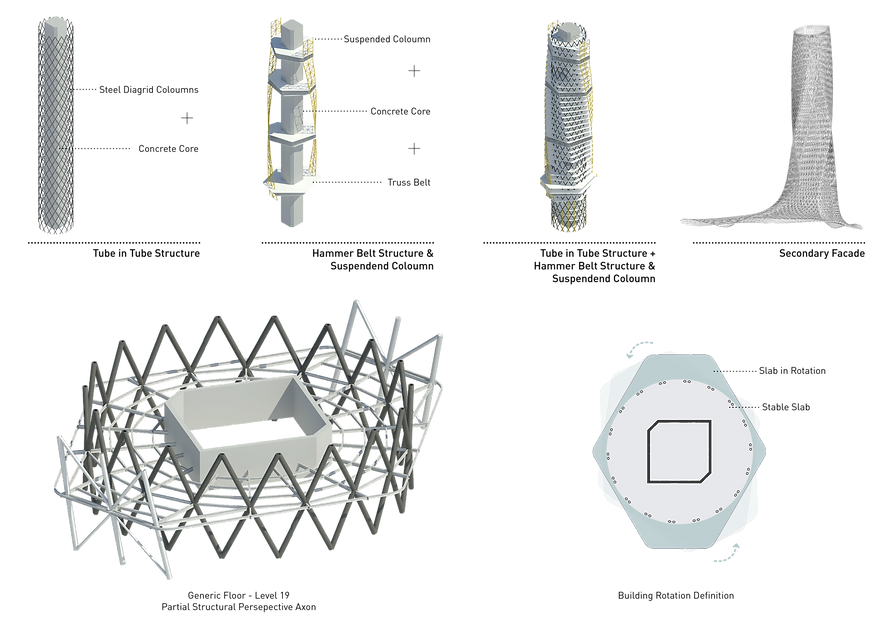
The site is located in the capital of Australia - Canberra. It was chosen because of the lack of a symbolic structure or sculpture which are showing the power of the city. Moreover, due to global warming, tremendous fires happened in Canberra and affected it too much. However, not only the city but also many animals and plants were influenced by that disaster. Therefore, in this design, one of the main ideas is to help nature and humans. The building function is Recovery & Research Center for the Ecosystem. Though, one may wonder why does Canberra need a tall building? In general, it is easy to say that there are 3 important reasons to build a skyscraper: using the least space - not touching pure nature, monitoring the fire, a building built to respond to natural disasters must be close to the scene. The skyscraper has an observation point on the top which is helping for monitoring fire and other emergency things, it also consists of a hotel part and restaurant for workers and public use. In the process topographic features, environmental potential, user requirements, and the city identity influenced the design. Last but not least reason is to find a new attraction and a new statement in the city.
Concept of the project

Site analysis & Context
Coordinator:
Antonio Mannino
A

Design process

Coordinator:
Maria Grazia Folli
A
Masterplan

Function composition


Section & Vertical circulation
Coordinator:
Marco Imperadori


BIM Development
VELUX & DELUX light visualisers
It can be seen two different daylight factor levels with and without external facade and how it affected the result. In the beginning, the analysis was held without the second facade structure - aluminum panels, and it was a tremendous overheating and the percentage of the daylight factor was bigger than the regular one, so the crucial decision was made. The second facade was added, moreover, it had been agreed to close some of its openings with photovoltaic systems - «kill two birds with one stone». The outcome appeared to be remarkable - the percentage of daylight factor decreased and became an average one.

Radiation analysis & Secondary facade design

MEP & Construction phase simulation

Coordinator:
Corrado Pecora
A
Structural development